
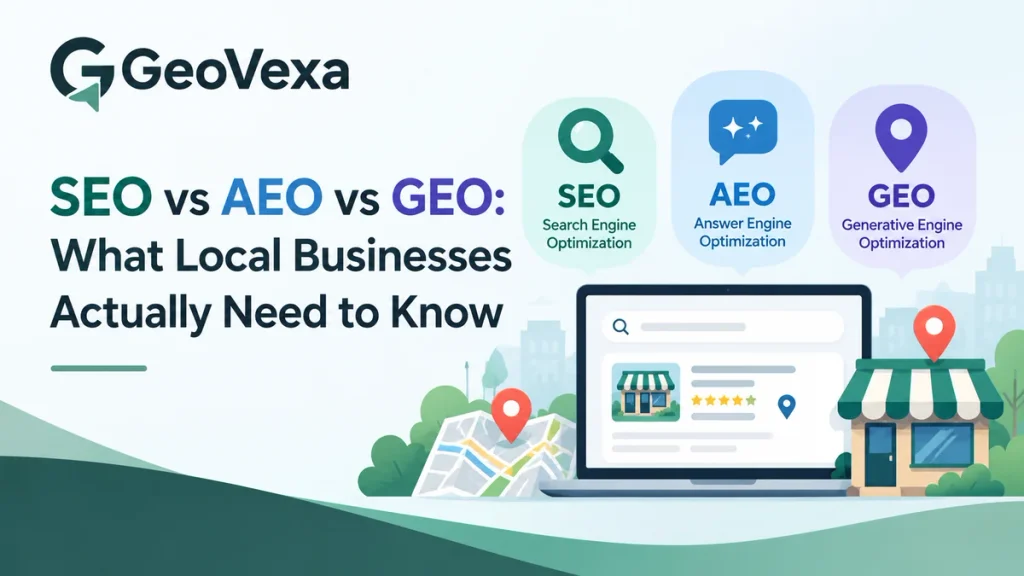
Ask Google, ChatGPT, and Perplexity for the best plumber, dentist, or roofer near you, and you will not get the same kind of answer from each. Google shows a map pack and a list of links, and often an AI summary above them. ChatGPT and Perplexity write a short recommendation and name a few businesses. As search splits like this, three acronyms keep showing up in marketing pitches: SEO, AEO, and GEO. Agencies use them loosely, and plenty of business owners end up paying for something they do not fully understand.
This guide explains what each one means in plain terms, how they differ, and what a local business should do about them.
SEO is still the foundation
SEO is the work of making your website and Google Business Profile show up when people search. It covers keywords, page content, technical health, backlinks, reviews, and local signals such as your business profile and directory listings. Success is measured in rankings, map pack visibility, traffic, calls, and form fills.
It is tempting to think AI search makes this obsolete. It does not. AI tools lean on the same material SEO produces: well written pages, a trusted website, accurate business details, and real reviews. Google’s AI summaries tend to pull from pages that already perform well in regular search, and other AI assistants draw on what they can find and trust across the open web. If your SEO is weak, the other two have very little to work with.
What AEO means
AEO stands for answer engine optimization. The goal is to have your content used as the direct answer when someone asks a question. That might be a featured snippet on Google, a spoken answer from a voice assistant, or a line inside an AI Overview.
The work is mostly about clarity. You write pages that answer one question at a time, put the answer near the top, and add detail below. A plumber’s page on how much a water heater replacement costs should give a price range in the first couple of sentences, not bury it after four paragraphs about the company’s history. Short headings written as real questions, plain answers, and a few well chosen details such as price factors, timelines, and service areas all make it easier for a search engine or an AI tool to lift your answer. Structured data such as local business schema also helps machines understand who you are, what you do, and where you work.
AEO is a content job at its core. It rewards plain, specific, trustworthy writing, which is also what good SEO content looks like.
What GEO means
GEO stands for generative engine optimization. It focuses on tools like ChatGPT, Gemini, and Perplexity, which write an original answer by combining information from many sources instead of lifting a single snippet. When someone asks one of these tools for a recommendation, it names specific businesses. GEO is the work of becoming one of them.
Because these tools form a picture of your business from many places, GEO reaches well beyond your own website. It covers whether your name, address, services, and description are consistent everywhere they appear, whether credible third parties mention you, how many real reviews you have and what they say, and whether your brand is clearly tied to the service and the city you want to be known for. In other words, it is about reputation and consistency across the web, not just on-page edits.
One warning is worth giving here. Some agencies use GEO to mean geographic or location based optimization, which is a different thing. Ask any provider to define the term before you agree to buy it.
How the three fit together
A simple way to hold them in your head is this. SEO gets your business found in search results, AEO gets your answers used, and GEO gets your business recommended. They overlap heavily. A strong Google Business Profile helps all three. Clear service pages help all three. Honest reviews help all three. The difference is mostly in where you spend your extra effort once the basics are solid.
Picture a homeowner with a leaking pipe. SEO helps them find your company in the map pack. AEO helps your page answer whether a leaking pipe counts as an emergency, so your answer appears in the snippet or the AI summary. GEO helps ChatGPT mention your company when they ask it for a trusted emergency plumber nearby. Same customer, same problem, three different places where you can win or lose the job.
What a local business should do first
Start with the basics, because everything else sits on top of them. Claim and complete your Google Business Profile, with the right categories, services, hours, photos, and a description that says plainly what you do and where. Keep your business name, address, and phone number identical across your website and directories. Ask real customers for reviews on a steady basis, and reply to them.
Next, fix your service pages. Each main service and each main service area should have its own page that explains what you do, who it is for, what affects the price, and how to book. Add a short FAQ to each page using the questions customers actually ask you on the phone. This is where answer focused writing pays off, since those same questions are what people type or speak into search boxes and AI tools every day.
Then work on the signals outside your website. Get listed in the directories that matter for your industry, earn mentions from local organizations, suppliers, and news sites, and make sure your website, profile, and social pages describe your business the same way. Some owners handle all of this in house. Others bring in help with answer engine optimization for page structure and with generative engine optimization for brand and entity signals, especially when they have several locations or a lot of pages to fix.
Mistakes to avoid
The first mistake is dropping SEO to chase AI. Most local customers still start in Google and the map pack, and AI tools lean on the same foundations. The second is believing anyone who guarantees you will rank in ChatGPT. These tools give different answers to different people at different times, so nobody controls the result.
The third mistake is publishing thin pages stuffed with question headings but no real answer underneath. A heading that asks a question only helps if the paragraph below it answers the question properly. The fourth is inconsistent business information. If your hours, address, or services differ between your profile, website, and directories, both search engines and AI tools struggle to trust you. The fifth is ignoring reviews, which are one of the clearest signs that a business is real and worth recommending.
How to tell if it is working
Measurement is the weak spot of AI search, so be realistic about it. For SEO, you can track rankings, map pack visibility, calls, and form submissions. For AEO, watch whether your pages win featured snippets or show up in AI Overviews for the questions you target.
For GEO, the practical method is simply to ask. Once a month, put the questions your customers ask into ChatGPT, Gemini, and Perplexity, with your city included. Note whether your business is mentioned, what is said about it, and which competitors appear instead. Keep a simple log so you can see change over time. It is not perfect, but it tells you more than a vendor’s dashboard claim ever will.
Do you need all three?
Most local businesses do not need three separate strategies. They need one solid local SEO foundation, pages written to answer real questions, and a reputation that is consistent and easy to verify. Do those well and you are covered across all three. Beyond that, put effort where your customers actually look. If they still find you through Google Maps, protect that first. If they increasingly ask AI tools for recommendations, add the answer and brand signals on top.
The businesses that gain most from this shift are not the ones chasing every new acronym. They are the ones whose information is accurate, whose pages give real answers, and whose customers say good things about them in public.
Frequently asked questions
What is the difference between SEO, AEO, and GEO?
SEO helps your website and Google Business Profile rank in search results and the map pack. AEO structures your content so search engines and AI tools can use it as a direct answer. GEO builds the brand and reputation signals that make tools like ChatGPT, Gemini, and Perplexity mention and recommend your business.
Do I still need SEO if I focus on AEO and GEO?
Yes. AEO and GEO both build on a strong SEO foundation. Most local customers still start with Google and the map pack, and AI tools rely on the same trusted pages, accurate business details, and reviews that good SEO produces.
Can anyone guarantee my business will appear in ChatGPT or Google AI Overviews?
No. These tools can give different answers to different people at different times, and no agency controls what they say. A provider who promises a guaranteed spot is making a claim they cannot back up. What you can do is make your business easy to find, easy to understand, and easy to trust.
How long does it take to see results from AEO and GEO?
It varies. Rewriting a page so it answers a question clearly can change how that page performs fairly quickly, while building consistent mentions and reviews across the web takes longer. Treat it as ongoing work and check your visibility monthly rather than expecting a one time fix.
Does my Google Business Profile matter for AI search?
Yes. It is one of the clearest sources of accurate information about your business, and it feeds both Google’s local results and the wider web. A complete profile with consistent details and steady reviews supports your SEO, your answers, and the way AI tools describe you.